


Production Line Solution
Your Professional Production Line Solution Supplier
Our company was founded in 2005, at the beginning of the establishment engaged in the design and production work of metal hose, metal pipe fittings and other metal products. In 2007, we began to develop rubber recycling equipment and rubber machinery products, and in 2008 to the market. In 2013, we developed complete equipment for rubber asphalt modification.


Why choose us
Our Factory
Our company is located in Wuxi, JiangSu Province, 150 kilometers away from Shanghai, Nanjing, north of the Yangtze River, transportation is very convenient. We mainly engaged in the research and development, production and sales of rubber machinery and metal products.
Production Market
Our products have been sold to Southeast Asia, North Asia, Eastern Europe, Australia, America and other markets; Achievements: tire recycling equipment in Malaysia; tire recycling production line in Russia, Ukraine and Turkey; tire recycling rubber asphalt modifier production line in New Zealand , etc
Our Certificate
GB/T19001-2016/ISO9001:2015 QUALITY MANAGEMENT SYSTEM CERTIFICATION.Patent number:ZL 2019 2 1443405.7 ZL 2019 2 1443434.3 ZL 2019 2 1443437.7 ZL 2019 2 1443820.2
Our After Sale
Our company regularly visits users to understand the use of products and help solve various problems that may be encountered in the process of use. At the same time to solicit suggestions for quality and technical improvements, in order to better serve users;Provide guidance information and technical assistance for users to install and debug the products sold free of charge;

The realm of production line in reclaimed rubber encompasses a wide range of equipment designed to process rubber materials efficiently and effectively. These machines play a crucial role in the rubber industry, enabling the transformation of raw rubber into valuable products used in various applications. From automotive parts to industrial seals, production line in reclaimed rubber are indispensable in the production chain. They are engineered to handle different types of rubber, offering flexibility and precision in operations. As the demand for rubber products continues to grow, the importance of production line in reclaimed rubber in the manufacturing process cannot be overstated.
|
Screw outer diameter |
200mm |
|
Type of screw thread |
Double-heads , equidistance & isobathic type |
|
L/D ratio |
5 |
|
Speed |
47.4 r/min |
|
Main motor model |
Y315M-8 |
|
Main motor power |
75KW |
|
Main motor speed |
740r/min |
|
Cutting device motor power |
1.5KW |
|
Cutting device speed |
16 r/min |
|
Steam pressure |
0.5-0.7MPa |
|
Production capacity |
800kg/hr |
|
Overall dimension ( L x W x H ) |
4229×2120×1500 mm |
|
Weight |
7000kgs |
Environmental Protection
The new production line utilizes sealed desulfurization to reduce waste gas and wastewater emissions. For example, one intelligent production line achieves zero emissions of "three wastes," meeting green manufacturing standards.
Efficiency and Continuity
The automated control system monitors the entire process, reducing manual errors and improving production stability.
Energy Savings and Cost Optimization
Recycled rubber is cheaper than virgin rubber and can be used in place of virgin rubber in proportion, significantly reducing raw material costs.
Improved Product Quality
The refiner utilizes low-temperature processing technology to prevent overheating and aging of the rubber compound, improving mechanical properties (such as tensile strength and wear resistance) by 12%-15%.
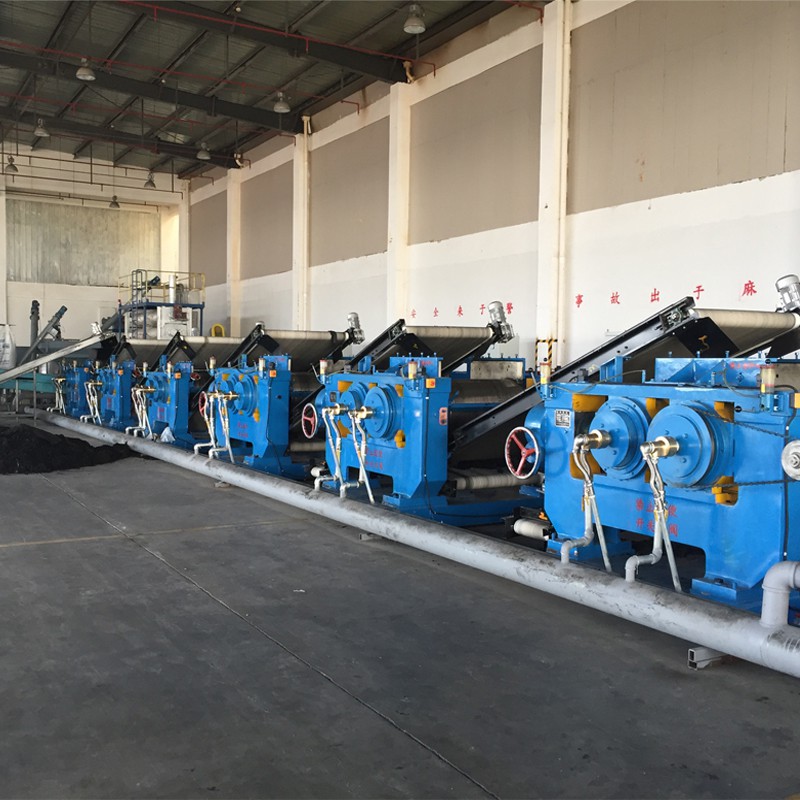
Types of Reclaimed Rubber Production Line
Waste Tire Shredder
The first stage in the recycling process, the waste tire shredder breaks down whole tires into smaller, manageable pieces. Equipped with high-strength, wear-resistant blades, these machines efficiently cut through rubber, steel, and fabric layers. Shredders are available in both horizontal and vertical configurations, with horizontal models typically offering higher throughput and better material uniformity.
Rubber Crusher
Following shredding, the rubber crusher further reduces tire chips into fine granules (typically 2–10 mm). Utilizing heavy-duty rollers or impact hammers, this machine ensures consistent particle size, which is crucial for effective devulcanization.
Magnetic Separator
After mechanical size reduction, steel wires and other ferrous metals must be removed to prevent damage to downstream equipment and contamination of the final product. The magnetic separator uses powerful electromagnets or permanent magnets to extract metal fragments from the rubber stream.
Fiber Separator
Textile fibers from tire cords can compromise the purity and performance of reclaimed rubber. The fiber separator employs air classification technology—using precisely controlled air jets—to lift and remove lightweight fiber strands from the heavier rubber particles.
Rubber Granule Feeder
This automated feeding system ensures a steady, uniform supply of processed rubber granules into the devulcanization chamber. Equipped with variable-speed conveyors or screw feeders, it maintains optimal flow rates and prevents clogging or overloading, contributing to smooth and efficient operation of the core processing unit.
Packaging Machine
The final stage involves packaging the reclaimed rubber into standardized bags or containers for storage, transport, and sale. Modern packaging systems are often automated, offering features like weight control, sealing, labeling, and palletizing, ensuring product readiness for industrial use.
Applications of Reclaimed Rubber Production Line
Tire Recycling Companies
As the primary users of reclaimed rubber technology, tire recycling companies process millions of end-of-life tires annually. These facilities use advanced devulcanization techniques to break down vulcanized rubber into a reusable form suitable for blending into new rubber compounds.
Construction Materials Manufacturers
Reclaimed rubber enhances the performance of various construction materials, particularly those requiring flexibility, impact resistance, and waterproofing. Its integration improves durability and reduces cracking under stress.
Flooring Products Manufacturers
Reclaimed rubber is ideal for resilient flooring solutions due to its cushioning, slip resistance, and sound-dampening properties. Production lines enable consistent quality and customizable formulations for diverse applications.
Industrial Products Manufacturers
Due to its excellent resilience, abrasion resistance, and ability to withstand dynamic stress, reclaimed rubber is widely used in industrial components that demand reliability and longevity.
Automotive Product Manufacturers
Automakers and auto parts suppliers increasingly integrate reclaimed rubber into non-tire vehicle components to meet sustainability goals without compromising performance.
Sports and Leisure Product Manufacturers
Recreational and fitness equipment benefits from the elasticity, shock absorption, and durability of reclaimed rubber, making it ideal for consumer-facing products.
Specification & maintenance of Reclaimed Rubber Production Line
Production Capacity
The production capacity describes the amount of raw rubber material that the machine can process in a given time frame, typically measured in tons per hour (TPH). For example, a production line in reclaim rubber may have a capacity of 1-3 TPH.
Shredding/Crushing Size
Some rubber recycling machines have varying shredding or crushing sizes. Once rubber materials are introduced into the machine, they are broken down into smaller pieces. These variations can be as small as 1 inch or more than 6 inches. Some rubber crushing machines will allow operators to choose different sizes. Overall, smaller pieces are easier to process further and for reclamation.
Separation Technology
Different types of rubber recycling machines use varying separation technologies to extract specific components from rubber materials. Examples include magnetic separators, air classifiers, and vibrating screens, among others.
Power Requirements
Power requirements convey the amount of electrical energy the rubber recycling machine needs to operate effectively. It is usually expressed in kilowatts (kW) or horsepower (HP) and may differ depending on the size and capacity of the machine. A small rubber recycling machine will consume less power compared to a large industrial plant.
The level of automation
Some rubber recycling machines allow a high level of automation through advanced control systems and monitoring capabilities. Such machines have a low need for human intervention during the recycling process and can be managed and supervised from a single central console location.
Scheduled maintenance
• Inspection of components
Regular inspection should be done for key components of the rubber recycling machine, such as blades, screens, bearings, and belts, among others. Users should look out for signs of wear, damage, or looseness in any of the pieces. Identifying the issue early will allow operators to fix or replace the part quickly, preventing larger-scale equipment failure.
• Lubrication
Regular greasing of moving parts is important to prevent any premature wear and tear. It helps to improve longer equipment lifespans, reduce friction, and prevent overheating. Lubricants for moving parts should be suitable for the material and chosen as per the manufacturer's guidelines.
• Cleaning
Operators should regularly clean the rubber crushing machine and ensure that all built-up debris and leftover material are removed. Focus on critical parts, like the cooling channels. This will enhance overall operation efficiency and lower the risk of overheating caused by blocking up cooling areas.
FAQ