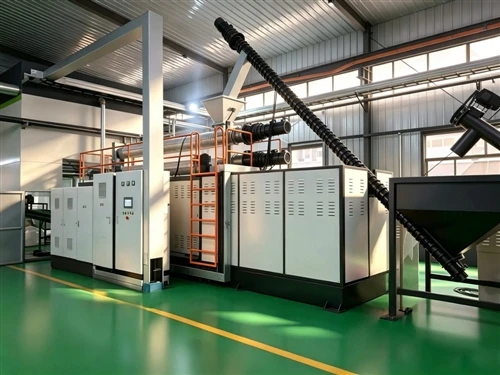
In today's highly competitive industrial landscape, the pursuit of efficiency, quality, and cost - effectiveness has led many manufacturing companies to turn to fully - automated production line solutions. As a reliable production line solution provider, we have witnessed firsthand the numerous advantages that such systems can offer across a wide range of industries. This article delves into these benefits, highlighting why a fully - automated production line is a strategic investment for modern businesses.
1. Enhanced Productivity
One of the most significant advantages of a fully - automated production line is the substantial increase in productivity. Automated systems can operate continuously, 24 hours a day, 7 days a week, without the need for breaks, vacations, or shift changes. Unlike human workers, machines do not experience fatigue, which means they can maintain a consistent level of output over extended periods. For example, in our Asphalt Modifier Production Line, the automated processes ensure a seamless flow of materials from raw material input to the final product. The precise control of mixing, heating, and cooling stages allows for a high - volume production rate that is difficult to achieve with manual labor.
Automation also reduces the time required for each production step. Robotic arms can perform repetitive tasks with incredible speed, such as picking and placing components, welding, or assembling products. This rapid execution of tasks shortens the overall production cycle, enabling companies to meet tight deadlines and increase their market responsiveness. In the case of our Rubber Granulation Production Line, the automated cutting and granulating processes are optimized to handle large volumes of rubber materials in a short time, significantly boosting the production capacity.
2. Improved Quality and Consistency
Quality control is a critical aspect of manufacturing, and fully - automated production lines excel in this area. Automated systems are programmed to perform tasks with a high degree of precision and accuracy. They can repeat the same operations with minimal variation, ensuring that each product meets the exact specifications. For instance, in the production of rubber products using our Waste Tire Recycling Rubber Powder Production Line, the automated sieving and sorting processes guarantee a uniform particle size of the rubber powder. This consistency is crucial for the performance and quality of the final products, such as rubber mats or tires.
Automation also reduces the risk of human error. Manual labor is susceptible to mistakes due to factors like fatigue, distraction, or lack of training. In contrast, machines follow pre - determined algorithms and can detect and correct errors in real - time. This results in a lower defect rate and higher overall product quality. Moreover, automated quality control systems can perform in - line inspections at every stage of the production process, identifying any deviations from the desired quality standards immediately. This proactive approach to quality control minimizes waste and rework, saving both time and resources.


3. Cost Savings
Although the initial investment in a fully - automated production line may be substantial, it offers significant long - term cost savings. First of all, labor costs are a major expense for many manufacturing companies. By automating the production process, the need for a large manual workforce is reduced. This not only saves on wages but also eliminates the costs associated with employee benefits, training, and recruitment. For example, in the operation of our Reclaimed Rubber Production Line, the automated system takes over most of the labor - intensive tasks, resulting in a significant reduction in labor costs over time.
Automation also leads to savings in material usage. Automated systems are designed to optimize the use of raw materials, minimizing waste. They can precisely measure and dispense materials, ensuring that the right amount is used for each product. Additionally, the reduced defect rate mentioned earlier means less material is wasted on defective products, leading to further cost savings. Energy efficiency is another area where automated production lines can make a difference. Modern automation technologies are designed to consume less energy compared to manual processes. For example, automated motors can be controlled more precisely to adjust the power consumption according to the production requirements, reducing the overall energy bill.
4. Increased Workplace Safety
Workplace safety is a top priority for any manufacturing company. Fully - automated production lines contribute significantly to creating a safer work environment. Many industrial processes involve hazardous operations, such as working with heavy machinery, high - temperature equipment, or toxic chemicals. By using automated systems, human workers can be removed from these dangerous tasks. For example, in the asphalt modifier production process, the automated mixing and heating operations eliminate the need for workers to be in direct contact with high - temperature asphalt, reducing the risk of burns and other injuries.
Automated systems are also equipped with advanced safety features, such as sensors and emergency stop buttons. These features can detect potential hazards and stop the production line immediately to prevent accidents. Moreover, the consistent and predictable nature of automated processes reduces the likelihood of human - error - related accidents, such as collisions or improper handling of equipment.
5. Scalability and Flexibility
A fully - automated production line offers excellent scalability and flexibility. As a company grows or market demand changes, the production line can be easily adjusted to increase or decrease the production capacity. For example, additional robotic arms or processing units can be added to the existing production line to boost the output. This scalability allows companies to respond quickly to market fluctuations without having to invest in a completely new production facility.
In terms of flexibility, modern automated production lines can be reprogrammed to produce different products or product variations. This is particularly beneficial for companies that operate in industries with rapidly changing product requirements. For instance, our production line solution can be adapted to produce various types of asphalt modifiers or different grades of rubber products by simply modifying the control software. This flexibility enables companies to stay competitive in a dynamic market environment.
6. Data Collection and Analysis
Automated production lines generate a vast amount of data during the production process. This data can be collected and analyzed to gain valuable insights into the production operations. For example, data on production speed, energy consumption, and defect rates can be used to identify bottlenecks in the production process and optimize the workflow. By analyzing the data, companies can make informed decisions about process improvements, resource allocation, and maintenance schedules.
Advanced analytics tools can also be used to predict equipment failures before they occur. By monitoring the performance data of machines, such as vibration, temperature, and pressure, predictive maintenance algorithms can determine when a machine is likely to break down. This allows for proactive maintenance, reducing unplanned downtime and increasing the overall equipment efficiency.
In conclusion, a fully - automated production line solution offers a multitude of advantages, including enhanced productivity, improved quality, cost savings, increased workplace safety, scalability, flexibility, and data - driven decision - making. As a production line solution provider, we are committed to helping businesses leverage these benefits to achieve their manufacturing goals. Whether you are in the asphalt modifier, rubber granulation, waste tire recycling, or reclaimed rubber production industries, our automated production line solutions can be tailored to meet your specific needs.
If you are interested in exploring how a fully - automated production line can transform your manufacturing operations, we invite you to contact us to discuss your requirements and explore potential collaboration opportunities. Our team of experts is ready to provide customized solutions and support to help you stay ahead in the competitive market.
References
- Groover, M. P. (2010). Automation, Production Systems, and Computer - Integrated Manufacturing. Pearson Prentice Hall.
- David, J., & Ramanujan, S. (2016). Handbook of Automation. Springer.
- Harrell, M., & Tumay, M. (2017). Lean Manufacturing in Process Industries: A Compelling Case for Change. CRC Press.